
Before Following Advice Online: How to Check Information About Firearms and Equipment
Five questions that can help you understand who is giving the advice, what it is based on, whom it suits and what requires further verification.
Content credit: Dor Ben Hamo — Shooting Instructor
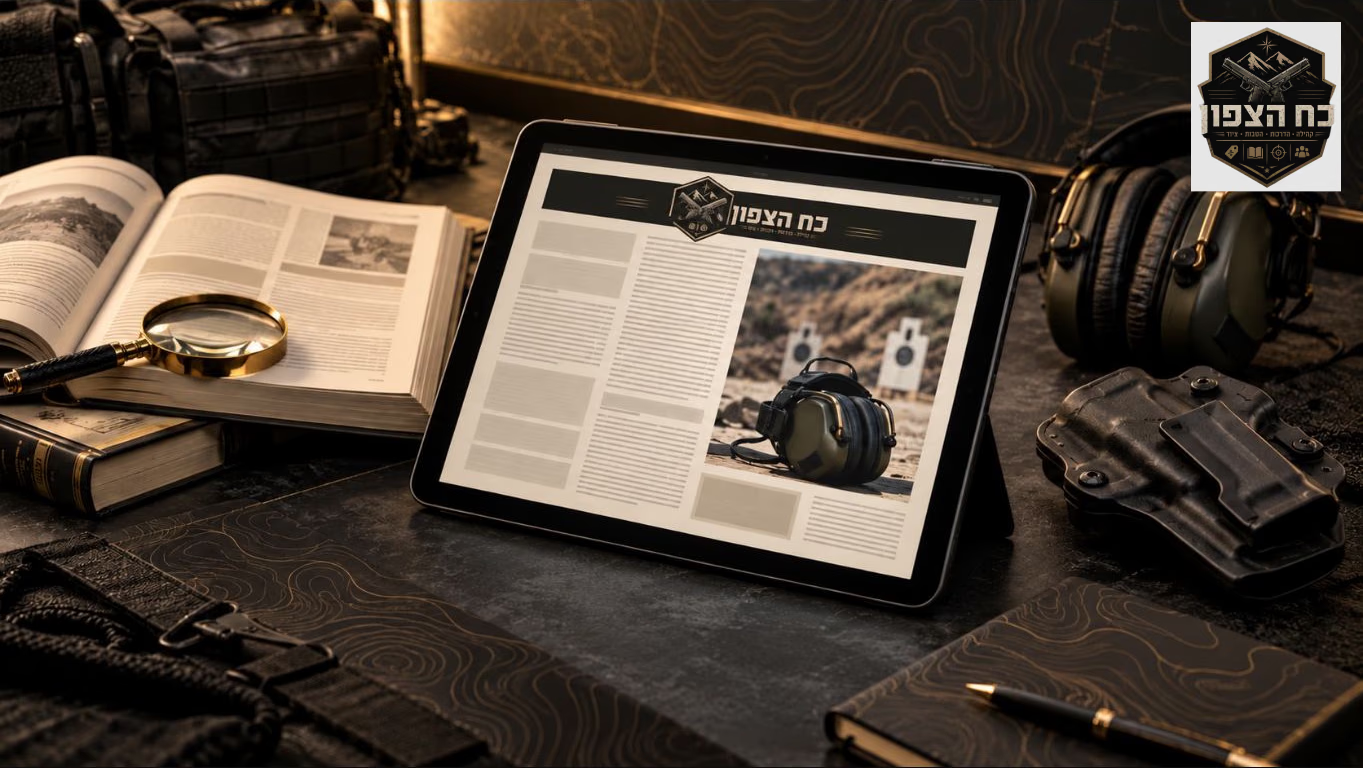
Credit: Koach Hatzafon — original article illustration
Personal experience, marketing content and professional guidance are different kinds of information — and it is worth knowing which one you are looking at.
A short video can be sharp, confident and persuasive. That is exactly why it is worth pausing before turning it into a decision about equipment, licensing or safety. A high view count shows reach; it does not explain how the claim was tested. Even a recommendation made with good intentions may be based on a different model, another country or conditions that are not relevant to you.
Reading professional content does not mean automatically distrusting everyone. It means giving each source the appropriate weight. A friend's experience can help you understand comfort and service; manufacturers' instructions are relevant to compatibility and maintenance; a question about a legal obligation in Israel requires a current official source and, at times, qualified legal advice.
Question One: What Exactly Is Being Claimed?
Break a broad statement into a claim that can be checked. “This is the best equipment” may refer to price, weight or comfort — three different questions. “You have to do it this way” may describe a law, a manufacturer's instruction or a personal preference. Without identifying the type of claim, it is easy to look for confirmation of the wrong thing.
Write the question in one sentence: Is this model compatible with my product? Is this guidance applicable in Israel? Does the figure relate to a tested use or a general promise? The more precise the question, the easier it is to find a useful answer.
Question Two: Who Is the Source, and What Is Their Area of Expertise?
Look for a clear identity, occupation and context. Experience in one field does not necessarily make someone an expert in every related question. An instructor can share valuable insights about learning; a product's warranty terms should also be checked with the service provider. A content creator may conduct a serious review, but it is still useful to know whether they received payment or a product for the review.
A commercial relationship does not prove that information is wrong. It is additional information that helps you assess the recommendation. Distinguish between a description of someone's impression and a promise presented as though it applies to every user.
Question Three: Can You Reach the Original Source?
Prefer a link to a document or the manufacturer's page over a cropped screenshot. Check the date, model and context. When several posts repeat the same message, they may all rely on one source. Multiple shares do not necessarily mean multiple checks.
For further reading on identifying false information, Israel's Ministry of Communications publishes a guide for media consumers. The existence of a guide does not verify any particular post; every claim still needs to be checked separately. Ministry of Communications guide to identifying fake news.

Check the source, date and model before adopting advice. Illustrative image.
Question Four: Does the Information Apply to My Situation?
Content from abroad can be very useful for understanding a product, but it should not be used to infer what is permitted or required in Israel. Even within the same equipment family, a version or accessory may change the answer. When a key detail is missing, write it down as an open question instead of filling the gap with an assumption.
For example, a review may praise a holster after use with a particular model. Your question is whether that exact holster model is intended for your specific configuration. This is a focused enquiry that can be directed to the manufacturer, importer or an appropriate professional.
Question Five: What Happens If the Claim Is Wrong?
Choosing the colour of a bag may come down to preference. A decision involving safety or an equipment modification requires a different level of verification. The more significant the consequences of an error, the more important it is to rely on an authoritative source and avoid experimenting on the basis of a video alone.
A Response That Moves the Discussion Forward
Instead of arguing about who “knows more”, politely ask for a link to the original instruction and ask which model and situation it concerns. If no answer is provided, the claim can remain unverified. An answer generated by artificial intelligence also requires source checking, especially when it includes citations or claims about current information.
The most important reading habit is to separate what is known, what is claimed and what still requires verification. A professional community can gain a great deal from sharing experience when it preserves this distinction.
This content is intended for general information and does not replace certified instruction, manufacturers' instructions, official guidance or relevant professional advice.
Written by
dor-ben-hamo
Related posts

Hammer-Fired or Striker-Fired — What Is the Difference Between Common Handgun Actions?
A professional comparison of hammer-fired and striker-fired pistols, focusing on operating feel, consistency, maintenance and training.
Read more
Handgun Glossary — The Complete Guide for Firearm Licence Holders
Barrel, slide, grip, magazine, and front and rear sights: a clear glossary that helps identify parts, read manufacturers' instructions and communicate precisely with professionals.
Read more
Single Action, Double Action and Striker-Fired — How Does a Pistol's Action Work?
A clear guide to the differences between common action types, what they mean for responsible use and the questions worth asking before choosing a firearm and training with it.
Read moreReady to grow?
Schedule a Call