
Responsibility Starts at Home: How to Talk with Your Family About Firearms
How to explain firearms to children, what to coordinate with other members of the household, and how to ensure the conversation supports safety without placing responsibility on children.
Content credit: Dor Ben Hamo — Shooting Instructor
Credit: Koach Hatzafon — original article illustration
A calm conversation, clear boundaries and preventing access — this is how personal responsibility becomes a family habit.
Most conversations about owning a firearm focus on the licence, training and equipment. But at home there is another conversation that deserves the same attention: what family members understand about this responsibility, what concerns them, and how to keep the rules clear even on a busy day. A responsible home is a place where people can ask questions and receive practical answers without feeling that the subject is off limits.
The guiding principle is simple: the licensed adult is responsible for preventing access. A child who knows a safety rule does not become responsible for enforcing it. Access to the safe is restricted to the licence holder, and children must also be prevented from accessing its keys or code. This is a requirement of the Firearm Licensing Division; beyond compliance, professional safety habits by a licensed firearm owner often prevent disaster.
Start by Listening
Choose a calm moment and ask: What do you know about the subject? Is anything worrying you? The answers may reveal a gap between what the adult thinks they explained and what the child actually heard. Some children associate firearms with a computer game, while others associate them with the news. There is no need to begin with a long lecture or a demonstration using a firearm. The goal is to make it clear that the subject can be discussed and that the rules are consistent.
Short language is suitable for younger children: if you see a firearm, do not touch it, move away and tell a responsible adult. Explain that there is no need to check whether it is real and no need to carry it to an adult. The message to move away and report it also appears in AAP recommendations. Information for parents.
With teenagers, the conversation can also cover peer pressure, photography and curiosity. Ask what they would do if a friend wanted to show them a firearm or if they saw a disturbing image in a group chat. The conversation is not a test of courage, and maturity does not need to be proved by approaching the equipment.
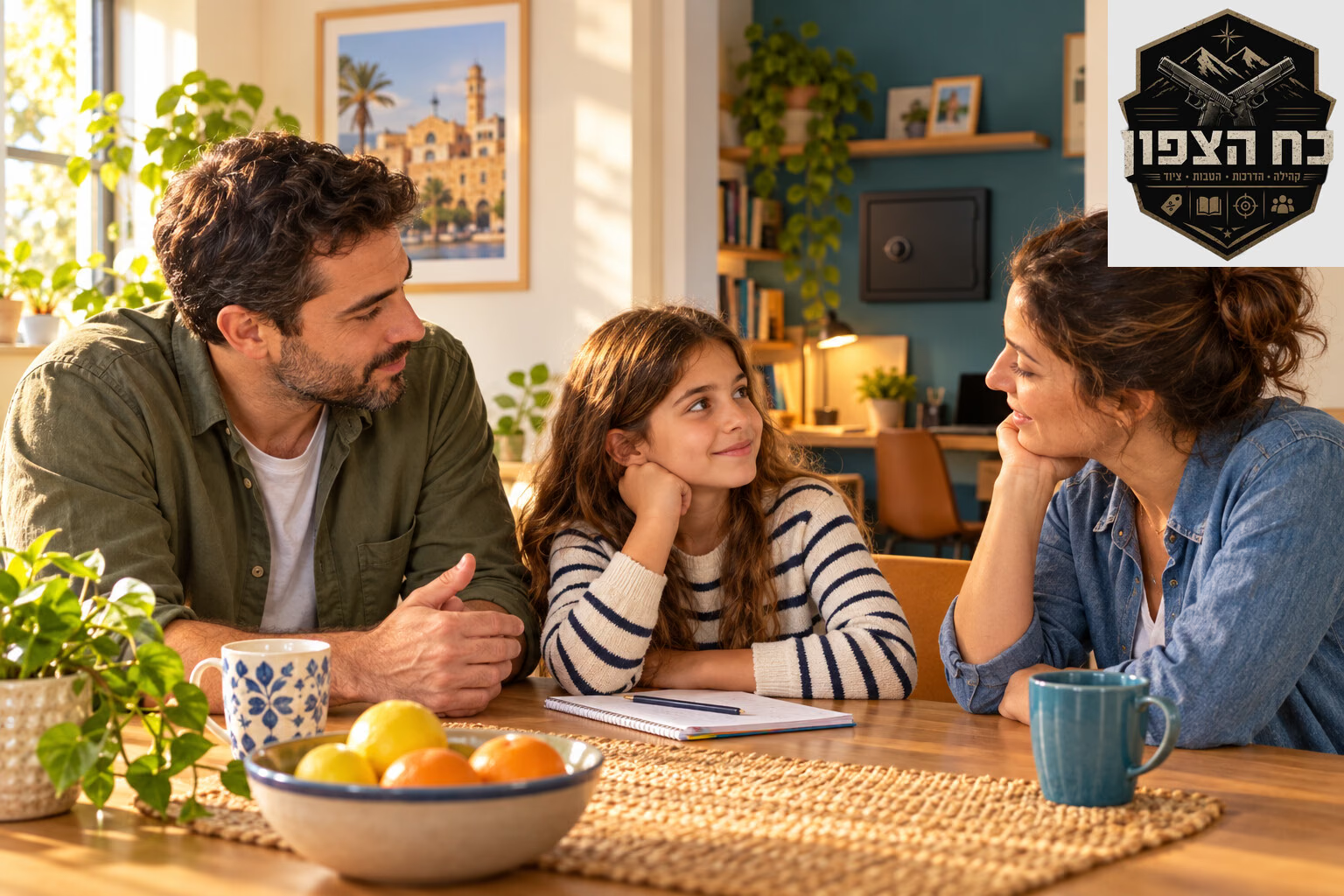
A clear family conversation helps children know whom to tell; responsibility remains with adults. Illustrative image.
Coordinate Expectations Between Adults
Differences between adults in the household may remain hidden until an uncomfortable moment. Agree in advance whom to approach when a question arises, how to handle visits by children, and what to do when household arrangements change. Moving home, hosting people for an extended period or changing the work routine are opportunities to check again that the habits remain clear.
Coordination is not a reason to grant access to the firearm. Storage arrangements must be checked against the official requirements that apply to the licence holder and the type of firearm. For this check, consult the Firearm Licensing Division's current page rather than relying on advice in a group. Firearm storage requirements — Ministry of National Security.
A Visit to Someone Else's Home Also Warrants a Question
Before a child visits a friend, it is natural to ask about allergies or supervision. You can also quietly ask about the safe storage of firearms, if there are any in the home. There is no need to question another parent about the type of equipment they own. The relevant question is whether children can gain access to it. The AAP recommends including the subject in checks before a visit. Child safety in friends' homes.
An Example of a Helpful Conversation
A child says that a friend told them their father owns a pistol. Instead of criticising the child's curiosity, you can reply: It is good that you told me. Even in someone else's home, we do not touch a firearm or remain near it; we move away and tell an adult. The adults can then clarify the storage arrangements between themselves. This teaches the child that reporting is the right action, not a reason for anger.
Three Questions to End the Conversation
- Do the children know whom to approach when one parent is not present?
- Do all the adults in the household understand that responsibility for preventing access remains with the licence holder?
- Is there a question or concern the family has not yet discussed?
There is no need to turn every evening into a briefing. A clear conversation that can be revisited is better than a one-time explanation given under pressure. Trust at home grows when words, boundaries and habits convey the same message.
This content is intended for general information and does not replace certified instruction, manufacturers' instructions, official guidance or relevant professional advice.
Written by
dor-ben-hamo
Related posts

Storing a Firearm at Home: What Is Important to Check
Proper storage begins with a locked home safe, preventing access by unauthorised people and periodically checking the storage environment.
Read more
Hammer-Fired or Striker-Fired — What Is the Difference Between Common Handgun Actions?
A professional comparison of hammer-fired and striker-fired pistols, focusing on operating feel, consistency, maintenance and training.
Read more
Handgun Glossary — The Complete Guide for Firearm Licence Holders
Barrel, slide, grip, magazine, and front and rear sights: a clear glossary that helps identify parts, read manufacturers' instructions and communicate precisely with professionals.
Read moreReady to grow?
Schedule a Call