
Grain, 9×19 and hollow points: an ammunition glossary
Bullet weights, cartridge dimensions, ballistics and recoil explained with manufacturer and standards-body sources.
Content credit: Dor Ben Hamo — shooting instructor
Credit: Koach Hatzafon — original article illustration
First: the bullet is not the whole cartridge
In everyday conversation, “bullet” often means a complete round. Technically, a cartridge consists of a case, primer, propellant and bullet. The bullet is the projectile that leaves the barrel. Keeping these terms separate helps when reading specifications or discussing a problem with an instructor. This follows the terminology in the SAAMI cartridge glossary.
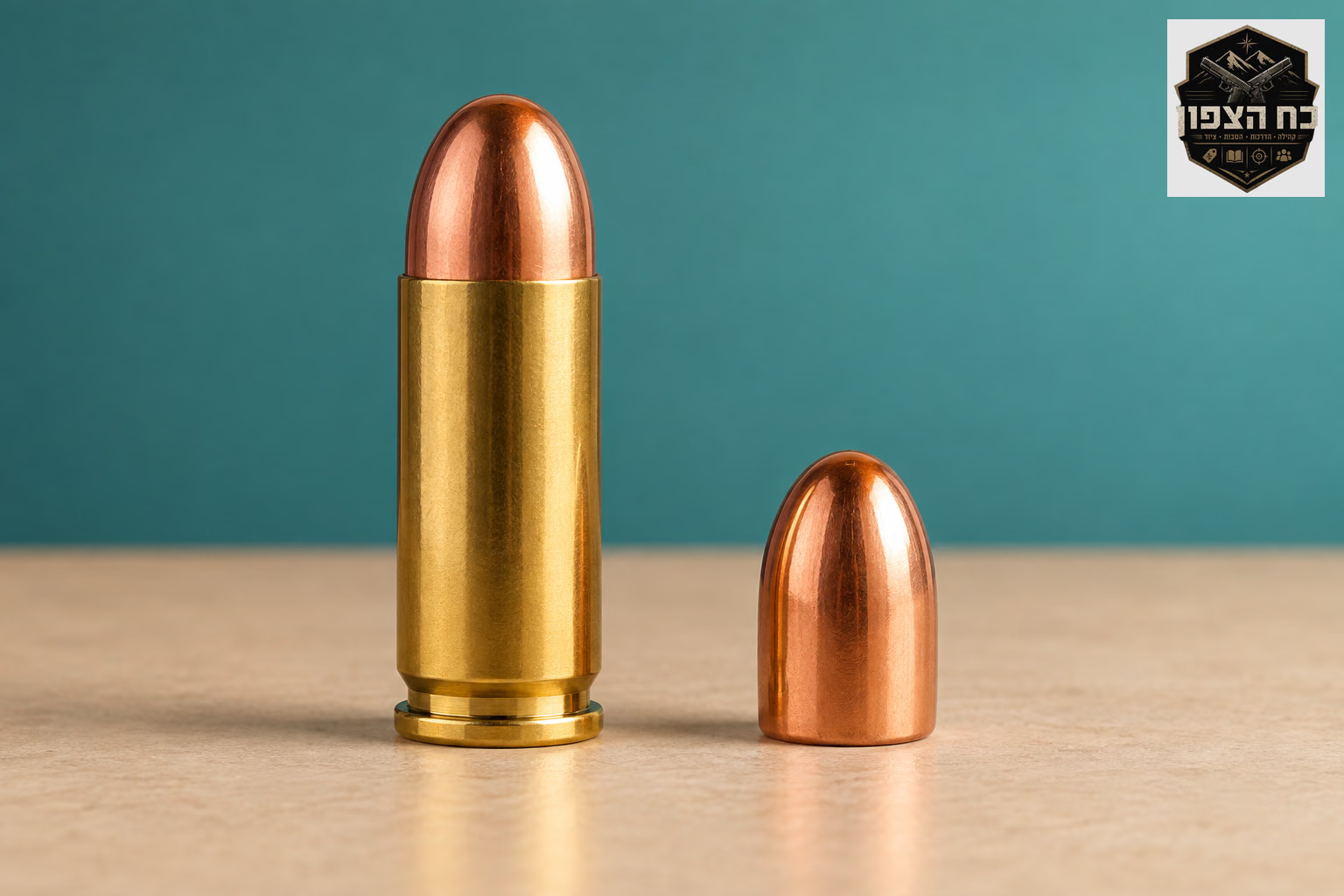
A complete cartridge on the left and a separate bullet on the right. Original generic illustration, not to scale or model-specific.
What is a grain?
A grain, usually abbreviated gr, is a unit of mass. On an ammunition box it normally identifies the bullet's weight. It is not the amount of propellant and is not a direct measure of power.
One grain equals 0.06479891 grams:
| Weight (gr) | Grams (approx.) |
|---|---|
| 115 gr | 7.45 g |
| 124 gr | 8.04 g |
| 147 gr | 9.53 g |
Weight alone does not tell you velocity, energy, accuracy or felt recoil. Read the complete manufacturer's specification, including the test barrel length.
Common weights in 9×19
115, 124 and 147 grains are familiar options in major manufacturers' current catalogues. For example, Federal's 9 mm Luger catalogue lists training and purpose-specific ammunition in these weights. They are different design choices rather than a ranking from good to best.
115 grains
This is a common training ammunition weight. In otherwise comparable cartridges, a lighter bullet generally travels faster. Recoil may feel relatively sharp, but that is not a universal rule: the complete cartridge and firearm matter.
124 grains
124 grains lies between 115 and 147 and is widely represented in ammunition catalogues. Its practical appeal is its position in the middle of the common weight range and the variety of products available. It is not automatically more accurate, softer recoiling or more reliable in every handgun.
147 grains
This heavier bullet travels more slowly in many 9×19 products. Some are subsonic, but that must be checked in the manufacturer's data. Felt recoil and point of impact may differ from lighter loads.
- 115 gr: Lighter and often faster
- 124 gr: A common intermediate weight
- 147 gr: Heavier and often slower These are broad tendencies, not guarantees for individual products.
What does 124 grains offer?
It is widely available, offered in many product lines and sits in the middle of the common 9×19 weight range. However, two cartridges carrying 124-grain bullets may differ in bullet construction, velocity and pressure characteristics. Matching bullet weight alone does not establish equivalent performance or handling. Follow the handgun manufacturer's instructions and assess functioning only in a lawful, controlled setting with qualified supervision.
Reading 9×19
The first number identifies the nominal caliber in millimeters; the second identifies nominal case length. It is a designation, not a complete set of cartridge measurements. 9×19 is also called 9 mm Luger or 9 mm Parabellum. Cartridge standards are published by C.I.P. and SAAMI.
9×19 and 9×17 are different cartridges
9×17 is also known as .380 Auto, 9 mm Browning Short or 9 mm Browning Court. Its nominal case length is 2 mm shorter. Similar nominal caliber does not make these cartridges interchangeable. Use only the cartridge designation authorised for the exact firearm in its markings and manual. Fiocchi also lists 9 mm Luger and .380 Auto as separate products.
How is 9×19 ballistics measured?
SAAMI distinguishes three areas:
- Internal ballistics: events from ignition until the bullet leaves the barrel.
- External ballistics: the projectile's flight.
- Terminal ballistics: its interaction with the target or test material.
Relevant measurements include bullet mass, muzzle velocity, muzzle energy, trajectory, dispersion and, for some ammunition tests, penetration and expansion. Test barrel length and conditions must be reported alongside the results.
Velocity can be measured with a chronograph. Kinetic energy is calculated as E = ½mv². Because velocity is squared, changes in velocity have a substantial effect on the calculated energy. Energy alone still does not describe a cartridge's complete performance.
A product-specific example is Federal Hydra-Shok 9 mm Luger, 124 gr, listed at 1,120 feet per second and 345 foot-pounds from a 4-inch test barrel. Those are figures for that product and test setup, not a promise for all 124-grain ammunition or handguns. Federal's ballistic tables note that results vary with equipment and conditions.
Recoil and felt recoil
As the bullet and combustion gases move forward, the firearm receives rearward momentum. What the shooter feels also depends on firearm mass, the movement of its mechanism, cartridge characteristics and the way the firearm is held. Bullet weight alone cannot predict that experience. A lighter, faster load can feel sharper, while a heavier, slower load may feel different over time; neither description applies universally.
What is a hollow point?
A hollow-point bullet has a cavity in its nose. JHP means Jacketed Hollow Point. Such construction is intended to promote expansion under the conditions for which the particular product was designed. Expansion is not guaranteed: impact velocity, construction and intervening materials affect the result. Federal's Hydra-Shok description, for example, discusses a centre post and jacket features in its design.
Possession and use are subject to applicable law, licence conditions and current guidance. A construction label alone does not establish lawful use, compatibility or reliable functioning in a particular handgun.
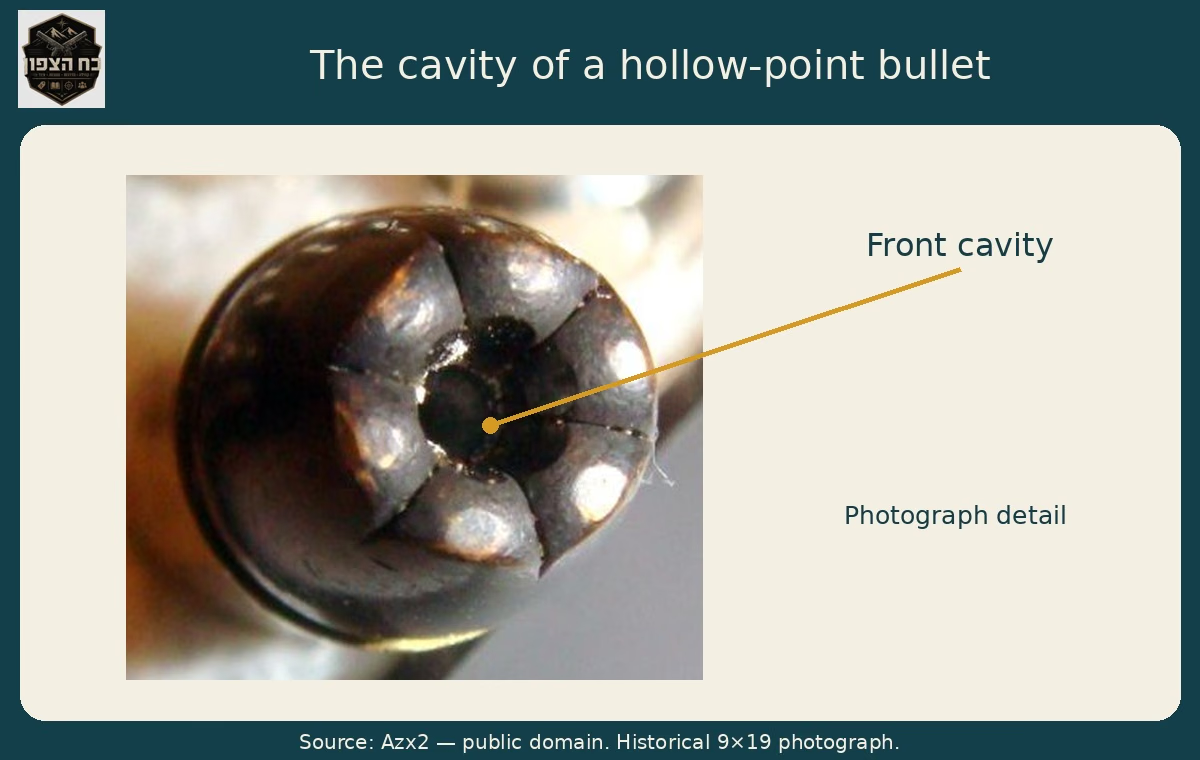
Close-up of a cavity in a 9 mm bullet tip. A historical photograph of one design, not a product recommendation or a representation of all hollow points.
What is a handgun's effective range?
There is no single figure for every handgun and shooter. “Effective range” can mean a ballistic characteristic, the ability to hit a specified target, or a person's repeatable performance under stated conditions. Target size, sights, ammunition, lighting and skill all matter.
A ballistic table extending to 100 yards is a calculation; it does not make 100 yards a recommended practical range. In supervised training, define the target and conditions, then assess repeatable performance. Small angular errors produce larger displacement as distance increases.
Reading ammunition information responsibly
- Identify the exact cartridge designation authorised for the firearm.
- Read the manual and ammunition packaging.
- Compare bullet weight, construction, velocity and test conditions together.
- Assess functioning only in a lawful, controlled setting.
- Follow applicable rules for training and other ammunition types.
- Record observations across a suitable supervised assessment rather than relying on one shot.
Grain describes weight, while 9×19 is a nominal dimensional designation. Neither is a complete measure of performance. 124 grains is a common intermediate weight, not an automatic advantage over 115 or 147 grains.
Sources
- SAAMI — cartridge terminology
- SAAMI — ballistics
- C.I.P. — handgun cartridge standards
- Federal — 9 mm Luger catalogue
- Federal — Hydra-Shok 124 gr
- Federal — ballistic tables
This is a terminology guide. It does not replace qualified instruction, manufacturer instructions or applicable official requirements.
Bullet close-up: Azx2, 2009, released into the public domain. Cropped, annotated and branded. Photograph and licence.
.jpg)
קליע בעל מעטפת מלאה לעומת קליע חלול
השוואה חזותית בין קליע בעל מעטפת מלאה לבין קליע חלול.
Written by
dor-ben-hamo
Related posts
Rifle calibers: dimension tables, names and example rifles
Ten familiar rifle cartridges explained through C.I.P. dimension tables, full names, example rifles and illustrated comparisons.
Read more
Ammunition Glossary — Primer, Case, Projectile, Rim and Chamber
The terms used in instructions, at the shooting range and in conversations with professionals — explained in clear, precise language.
Read more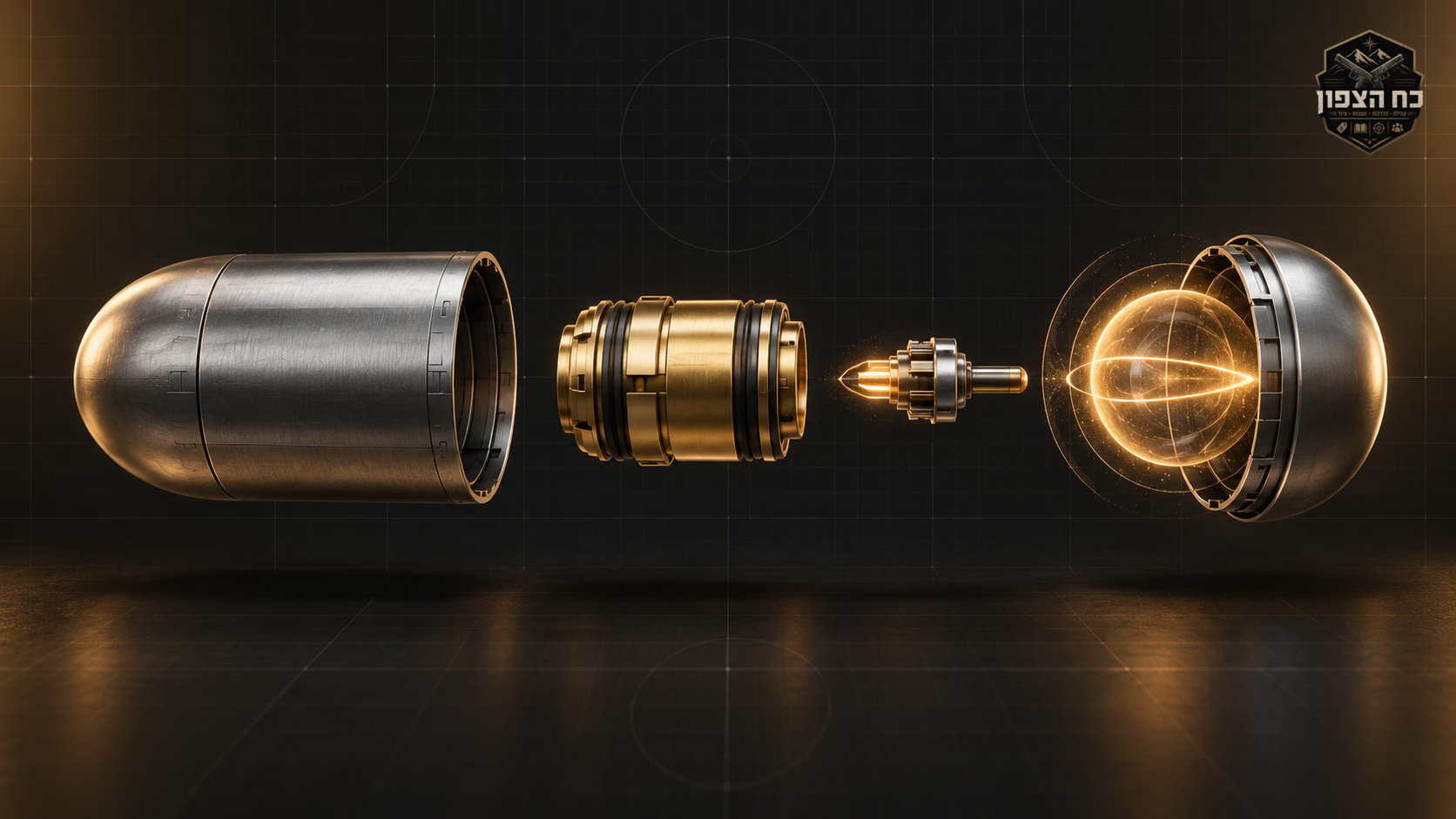
What Is a Handgun Cartridge Made Of? Four Components Worth Knowing
A clear conceptual explanation of the projectile, cartridge case, propellant and primer — and the difference between a “bullet” and a complete cartridge.
Read moreReady to grow?
Schedule a Call